
CartiHeal Agili-C · Treatment comparison
CartiHeal vs OATS osteochondral transfer
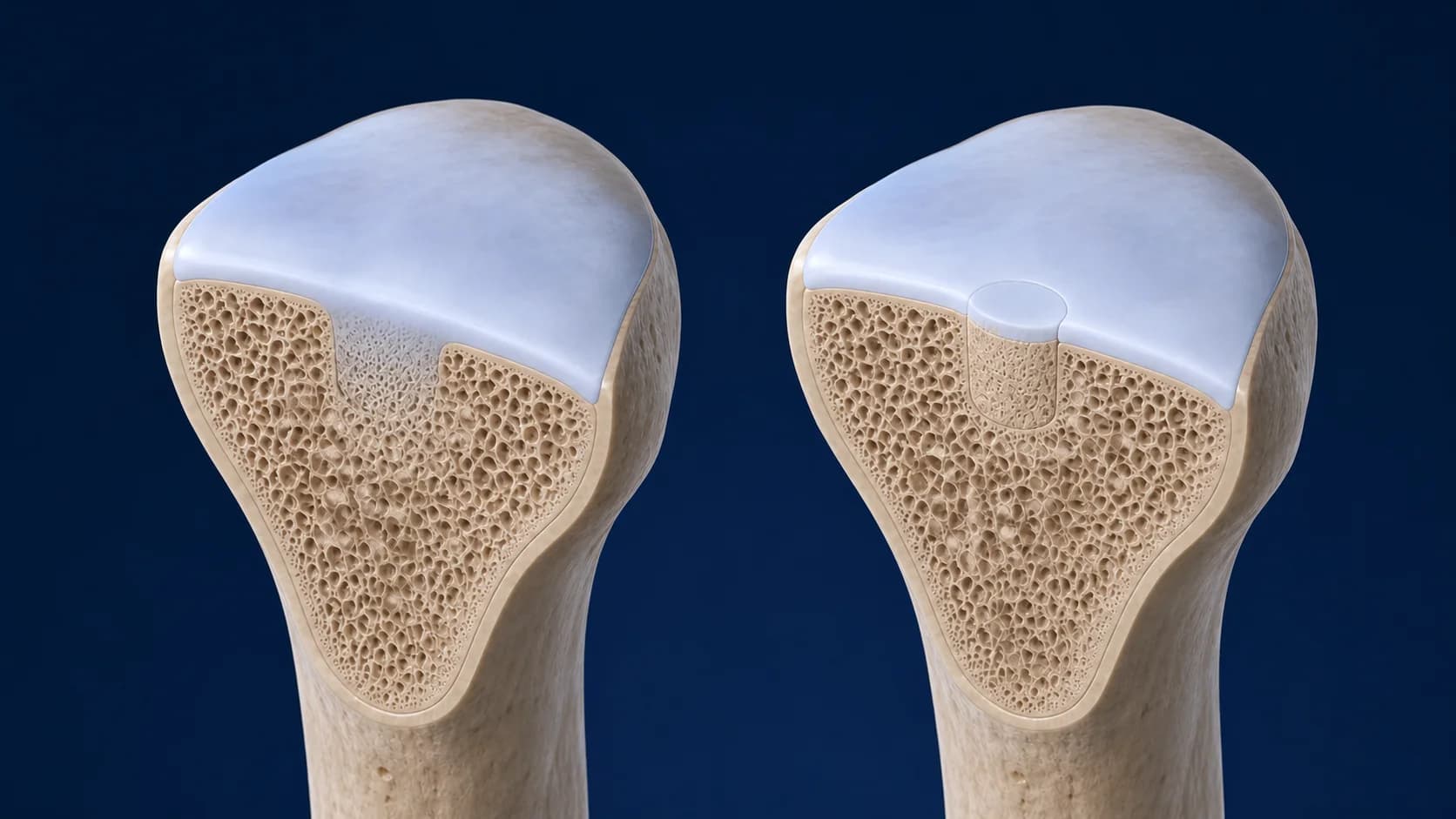
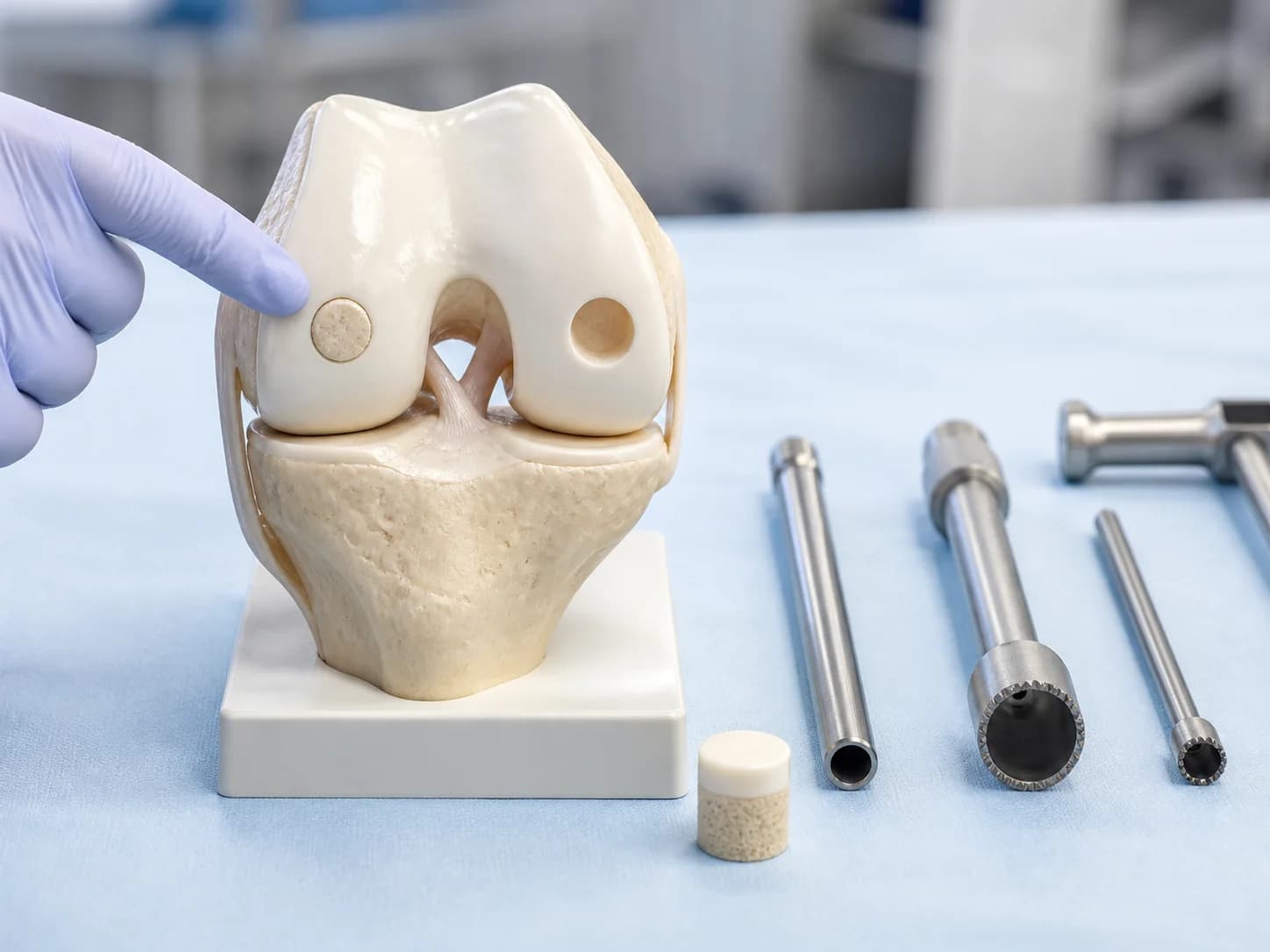
Both reconstruct cartilage and bone. CartiHeal uses an off-the-shelf scaffold intended to remodel into the patient’s own tissue; OATS moves a living cartilage-and-bone plug from another part of the same knee, creating a donor site.
 Reviewed byProfessor Paul Lee MBBch, FRCS (Tr & Orth), PhDCartilage and joint preservation expertise
Quick answer
CartiHeal avoids an osteochondral donor site but relies on scaffold integration and remodelling. OATS transfers living cartilage and bone immediately but is constrained by graft harvest and matching. There is no direct head-to-head trial established here.
Verified across three networks
Trusted by patients on Doctify, Google and Top Doctors
What fills the lesion
Off-the-shelf scaffold and autologous graft are fundamentally different
CartiHeal uses a manufactured porous aragonite implant intended to be progressively replaced by tissue. OATS transfers one or more osteochondral plugs from a lower-load area of the patient's own joint into the defect.
OATS therefore places mature hyaline cartilage and bone immediately but creates a donor site. CartiHeal avoids graft harvest but relies on scaffold integration and biological remodelling.
What fills the prepared site
Scaffold remodelling or living tissue transfer
CartiHeal
Manufactured biphasic scaffold
- Available off the shelf
- No cartilage-and-bone donor harvest
- Relies on integration, resorption and tissue replacement
OATS
Patient’s own osteochondral graft
- Transfers mature cartilage and bone
- Requires harvest from another part of the knee
- Relies on plug matching and integration at the recipient site
Technical constraints
Similar geometry does not make the operations equivalent
Size and contour
The joint-surface geometry must suit the selected reconstruction.
Lesion location
Access, loading and donor matching vary across the knee.
Donor-site trade-off
OATS moves tissue rather than avoiding the biological cost of harvest.
One or more sites
Plug number, spacing and available bone influence the plan.
Technical trade-offs
Both are osteochondral operations with different constraints
Both techniques prepare cylindrical sites across cartilage and bone. OATS is constrained by available donor tissue, plug matching and donor-site effects. CartiHeal uses selected implant sizes and can use multiple plugs while preserving an appropriate bone bridge.
Lesion size, geometry, location and surrounding cartilage influence whether either approach is sensible. Larger or more complex defects can lead to other graft or cell-based options.
Evidence comparison
There is no direct CartiHeal-versus-OATS trial here
CartiHeal has five-year randomised evidence against a debridement or microfracture control arm. That study does not establish superiority over OATS.
OATS has its own evidence base and long-established indications. Comparing separate studies is less reliable than a head-to-head trial because populations, lesions and outcomes differ.
Evidence boundaries
What the available studies can and cannot answer
CartiHeal trial
Compared the implant with debridement or microfracture control.
OATS evidence
A separate literature addresses graft transfer in its own populations.
No direct winner
Separate trials do not establish CartiHeal superiority over OATS.
Match the indication
The lesion and patient determine which evidence is most relevant.
Side-by-side
Scaffold remodelling or tissue transfer?
CartiHeal and OATS questions
Is CartiHeal a synthetic version of OATS?
No. Both fill an osteochondral site, but OATS transfers the patient’s living cartilage-and-bone plug while CartiHeal uses an off-the-shelf scaffold intended to remodel.
Does CartiHeal avoid a donor site?
Yes. It does not require harvesting osteochondral plugs from another area of the joint.
Has CartiHeal been proven better than OATS?
Not by the randomised study discussed here. That trial compared CartiHeal with debridement or microfracture control, not OATS.
Can both use multiple plugs?
Both concepts can use more than one cylindrical site in selected cases, but planning, constraints and technical guidance differ.
Still have more specific concerns?
Free Discovery CallOptions that our doctors may discuss include NanoACi, ChondroFiller, Mytocel MSK, joint replacement, established conservative care or surgery, depending on examination and imaging.
Match the cartilage operation to the lesion
Professor Lee can compare CartiHeal with osteochondral graft and other restoration options for the actual lesion pattern in your knee.