

CartiHeal Agili-C · Clinical research
What does the five-year CartiHeal evidence show?
The randomised study reports meaningful separation from debridement or microfracture at 60 months. The comparator, population and failures matter as much as the headline.
 Reviewed byProfessor Paul Lee MBBch, FRCS (Tr & Orth), PhDCartilage and joint preservation expertise
Quick answer
CartiHeal produced better five-year group outcomes than a debridement or microfracture control arm in the published randomised study. That is strong comparative evidence, but it is not a comparison with every cartilage operation and does not predict an individual result.
Verified across three networks
Trusted by patients on Doctify, Google and Top Doctors
Five-year study
The treatment groups remained separated at 60 months
In the published randomised study, mean KOOS at 60 months was 81.0 in the CartiHeal group and 59.1 in the control group. Clinical responder rates were 74.7% and 29.6% respectively.
Treatment failure was reported in 15.0% of the implant group and 35.7% of controls. Replacement or osteotomy occurred in 1.8% and 9.5% respectively. These are group outcomes, not predictions for an individual patient.
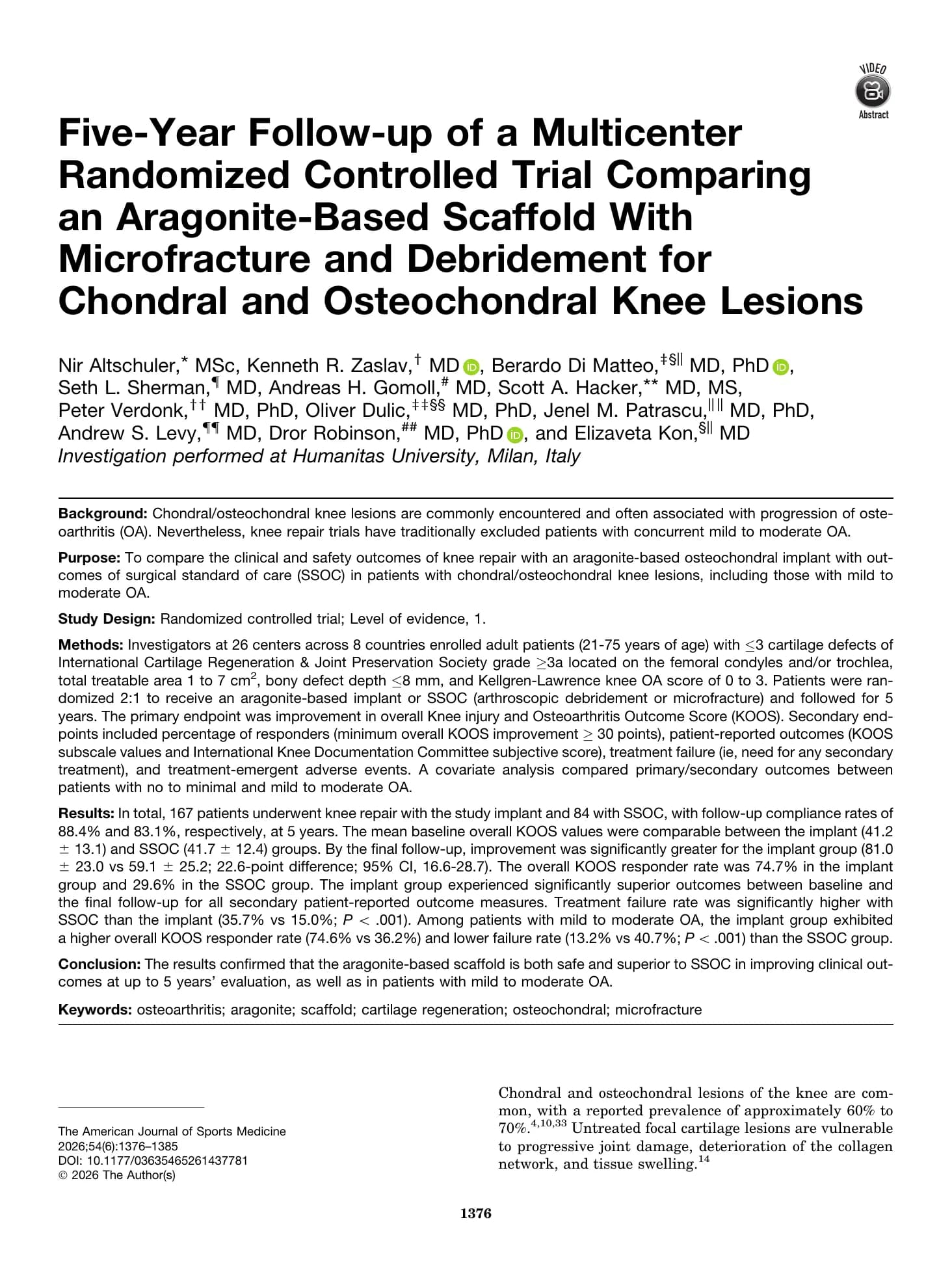
Primary five-year publication
Five-year follow-up of the multicentre randomised trial
The American Journal of Sports Medicine · 2026;54(6):1376–1385
Altschuler N, Zaslav KR, Di Matteo B, et al. DOI: 10.1177/03635465261437781
The paper reports outcomes through 60 months for the aragonite-based scaffold and the combined surgical standard-of-care control.
Trial architecture
What was actually studied
26
Clinical centres
Across eight countries.
251
Randomised participants
Allocated 2:1 to implant or control.
5 yr
Published follow-up
Outcomes reported to 60 months.
2
Control procedures
Debridement or microfracture—not one pure comparator.
What the comparator was
The control arm was debridement or microfracture
The trial did not compare CartiHeal with every cartilage operation. Its surgical standard-of-care control arm used debridement or microfracture. Conclusions should remain within that comparison.
It therefore cannot establish superiority over OATS, osteochondral allograft, cell-based repair, osteotomy or joint replacement. Those procedures address different lesion patterns and patient groups.
How to read the data
Strong comparative evidence still has boundaries
The study population included adults aged 21–75, up to three lesions, 1–7 cm² total area, ICRS grade 3A or higher and Kellgren–Lawrence grade 0–3. Subgroup findings can inform discussion but are less definitive than the primary randomised comparison.
Published results should be considered alongside adverse events, failures, rehabilitation, current instructions for use and independent assessment of whether the individual knee resembles the population studied.
Published 60-month results
Group outcomes, read in both directions
Mean overall KOOS (higher is better)
Clinical responders (higher is better)
Treatment failure (lower is better)
Side-by-side
Five-year group outcomes
Published 60-month results for CartiHeal compared with debridement or microfracture control.

Questions about the CartiHeal evidence
What was CartiHeal compared with?
The randomised control arm used debridement or microfracture. It was not a head-to-head comparison with every other cartilage restoration operation.
How long were patients followed?
The published outcomes discussed here extend to 60 months, providing five-year comparative follow-up.
Did everyone avoid failure?
No. Treatment failure was reported in 15.0% of the CartiHeal group at five years. The lower rate than control does not mean failure is eliminated.
Do the results predict my outcome?
No. Trial averages describe groups. Lesion pattern, mechanics, health, rehabilitation and other individual factors affect outcome.
Still have more specific concerns?
Free Discovery CallOptions that our doctors may discuss include NanoACi, ChondroFiller, Mytocel MSK, joint replacement, established conservative care or surgery, depending on examination and imaging.
Discuss the evidence in relation to your lesion
Professor Lee can explain how closely your knee resembles the trial population and whether CartiHeal or another cartilage operation is the more credible option.