
CartiHeal Agili-C · Treatment comparison
CartiHeal vs microfracture
Both are one-stage cartilage operations, but they build repair differently. CartiHeal provides an off-the-shelf scaffold for the cartilage-and-bone unit; microfracture relies on marrow cells and a clot. Five-year trial data favoured CartiHeal over the combined debridement/microfracture control.
 Reviewed byProfessor Paul Lee MBBch, FRCS (Tr & Orth), PhDCartilage and joint preservation expertise
Quick answer
Different repair strategy
CartiHeal places a scaffold across cartilage and bone. Microfracture creates marrow channels and relies on the clot that forms.
Five-year evidence
CartiHeal produced better outcomes than the trial’s combined debridement or microfracture control arm.
What decides in practice
Lesion depth, underlying bone and the mechanical health of the whole knee determine which operation is credible.
Verified across three networks
Trusted by patients on Doctify, Google and Top Doctors
Mechanism
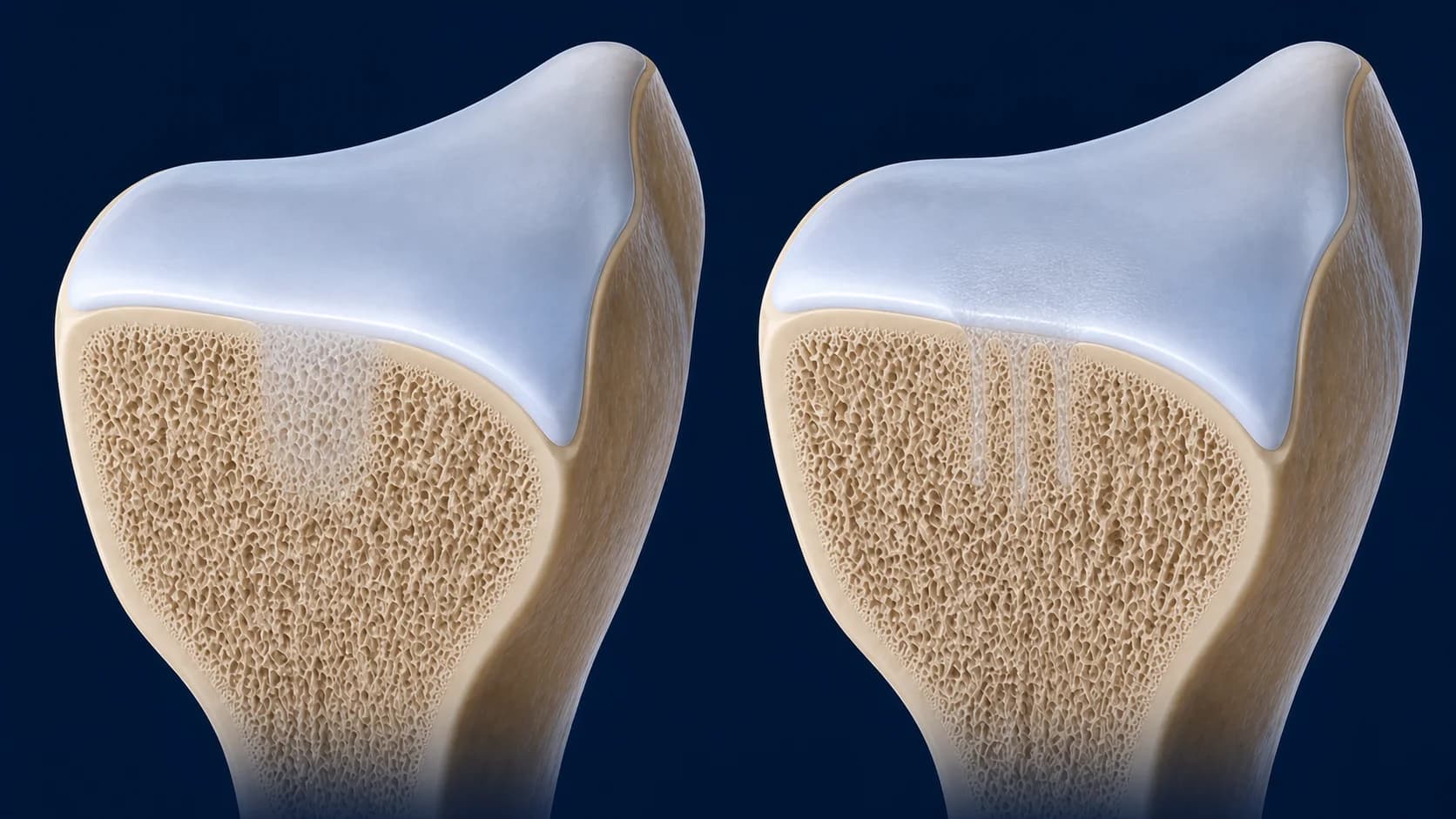
A biphasic scaffold and marrow stimulation take different routes
Both are single-stage operations, but the surgeon creates a very different repair environment in the focal defect.
- CartiHeal: a prepared cylindrical cartilage-and-bone site receives an off-the-shelf biphasic scaffold.
- Microfracture: small perforations in the subchondral plate release marrow elements into the prepared defect.
- CartiHeal aims to support distinct cartilage-like and bone-like repair zones as the scaffold remodels.
- Microfracture relies on a marrow clot and the repair tissue that develops from it.
Repair architecture
Two one-stage operations, two biological strategies
CartiHeal
Off-the-shelf osteochondral scaffold
- Cylindrical bed spans cartilage and bone
- Biphasic porous implant is seated in the site
- Scaffold is intended to resorb and remodel over time
Microfracture
Marrow-stimulation repair
- Damaged surface is prepared without a plug implant
- Small channels enter the underlying bone
- Marrow elements form a clot within the defect
Exact comparator
How to read the five-year statement
2
Control procedures
Debridement or microfracture formed the combined control arm.
5 yr
Published follow-up
Comparative outcomes were reported at 60 months.
Favoured CartiHeal
Mean KOOS, responder rate and treatment failure separated from control.
Not microfracture-only
The result must not be rewritten as a pure head-to-head comparison.
Trial interpretation
The randomised control was not microfracture alone
The five-year result is encouraging, but the comparator must be described accurately to be useful rather than promotional.
- Control arm: surgical debridement or microfracture, according to the assigned standard-of-care pathway.
- Follow-up: outcomes were reported through five years.
- Finding: CartiHeal produced better mean KOOS, responder and failure outcomes than the combined control arm.
- Limit: this was not a pure microfracture-only comparison in every control patient.
Choosing between operations
Lesion, bone, previous surgery and future options shape the choice
The operation should be selected for the actual defect and the mechanical health of the whole knee—not because one technique sounds newer or simpler.
- Defect size, depth and position on the joint surface
- Condition of the subchondral bone beneath the cartilage
- Alignment, stability, meniscus and surrounding cartilage
- Previous marrow-stimulation or cartilage surgery
- Rehabilitation capacity, symptoms and activity goals
Real-world selection
The named treatment is not the starting point
Lesion geometry
Size, depth, containment and location define the repair problem.
Underlying bone
The subchondral environment differs between cartilage lesions.
Whole-knee mechanics
Alignment, stability and meniscus function can dominate the decision.
Treatment history
Previous marrow stimulation or repair affects the options now available.
Side-by-side
Implant scaffold or marrow stimulation?
CartiHeal and microfracture questions
Did CartiHeal beat microfracture in the trial?
CartiHeal produced better outcomes than a control arm using debridement or microfracture. The most precise description is superiority to that combined control, not a pure microfracture-only trial.
Are both procedures single-stage?
Yes. Neither requires a separate cell-harvest operation, although the surgical techniques and biological strategies differ.
Do both involve bone?
Yes. Microfracture perforates subchondral bone; CartiHeal creates a prepared cylindrical bed extending into bone for the biphasic implant.
Which has the easier recovery?
Both require cartilage-protection rehabilitation. Exact restrictions depend on lesion, location, procedure and associated work, so the answer is individual.
Still have more specific concerns?
Free Discovery CallOptions that our doctors may discuss include NanoACi, ChondroFiller, Mytocel MSK, joint replacement, established conservative care or surgery, depending on examination and imaging.
Compare current cartilage options for your lesion
Professor Lee can assess whether the lesion and whole knee make CartiHeal, marrow stimulation or another cartilage operation the more credible route.