
CartiHeal Agili-C · Treatment comparison
CartiHeal vs MACI cartilage repair
CartiHeal is a one-stage scaffold for a cartilage-and-bone defect. MACI grows the patient’s cartilage cells on a collagen membrane and implants it in a second operation. Bone involvement, defect size and previous treatment shape the choice.
 Reviewed byProfessor Paul Lee MBBch, FRCS (Tr & Orth), PhDCartilage and joint preservation expertise
Quick answer
CartiHeal is an off-the-shelf osteochondral implant used in one operation. MACI harvests and expands the patient’s cartilage cells, then places them on a membrane during a later operation. The pivotal CartiHeal trial was not a direct comparison with MACI.
Verified across three networks
Trusted by patients on Doctify, Google and Top Doctors
Different repair architecture
One fills a cartilage-and-bone site; the other places cells on a membrane
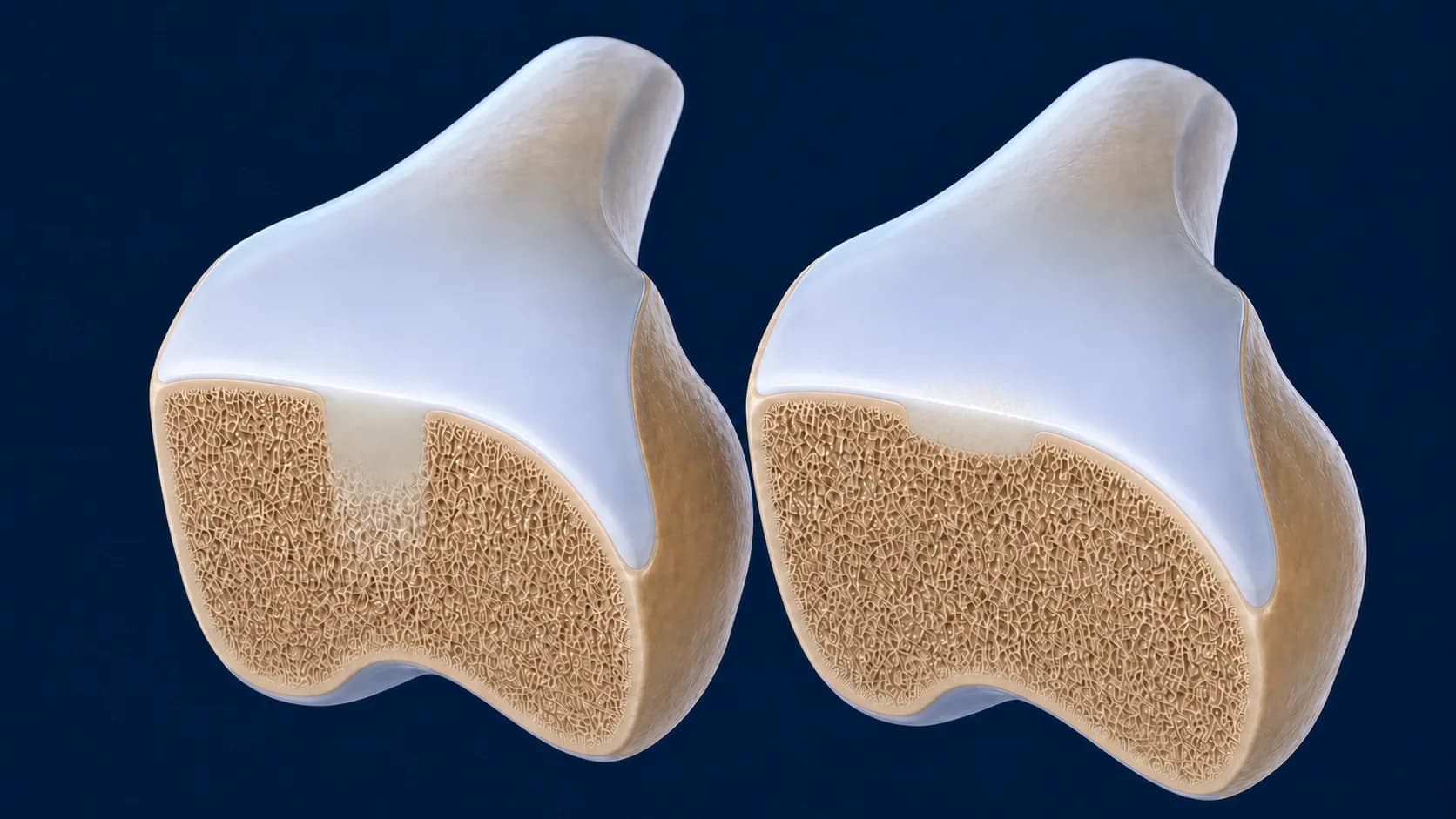
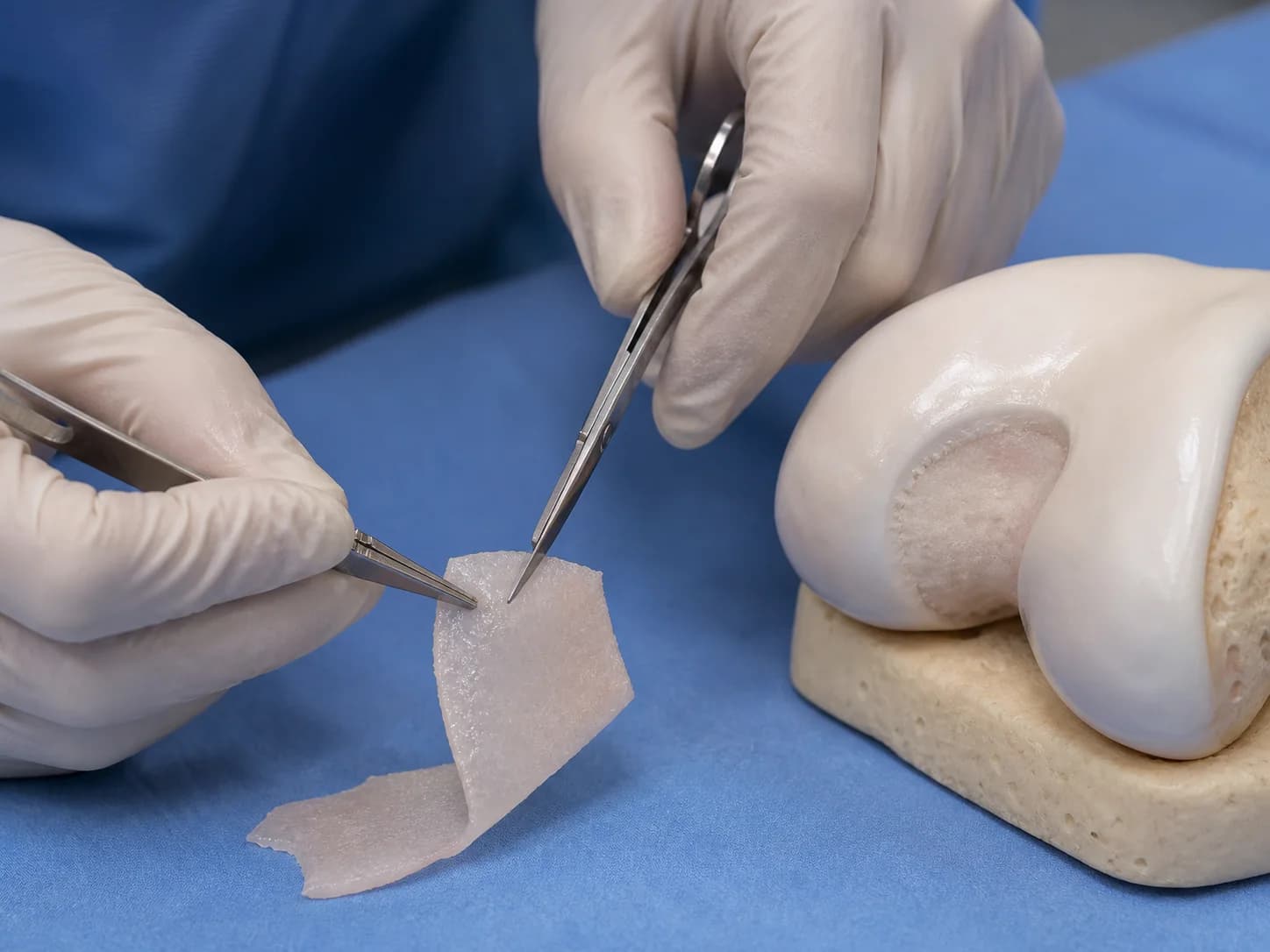
CartiHeal is seated within a prepared cylindrical osteochondral site. Its upper and lower zones are intended for the different environments of cartilage and subchondral bone.
MACI grows the patient's own chondrocytes after an initial harvest and seeds them onto a collagen membrane for implantation in a second operation. The matrix supports cell delivery at the cartilage surface rather than acting as the same kind of biphasic bone-and-cartilage plug.
Repair architecture
Osteochondral cylinder or cell-seeded membrane
CartiHeal
Porous biphasic implant
- Prepared cylinder spans cartilage and bone
- No patient-cell culture stage
- Scaffold is intended to remodel in situ
MACI
Cultured cells on a thin membrane
- Membrane is shaped to a cartilage-surface defect
- Patient cells are expanded before implantation
- Meaningful bone pathology may need separate treatment
Treatment burden
Stage count changes logistics, not the need for recovery
1
CartiHeal operation
No preceding cartilage-cell biopsy or culture interval.
2
MACI operations
Biopsy and culture are followed by later membrane implantation.
Protected loading
Both pathways need the repair site protected during early rehabilitation.
Long recovery
Single-stage does not mean immediate return to impact or sport.
Treatment burden
Single-stage does not mean simple recovery
CartiHeal avoids a separate biopsy and cell-culture interval. MACI involves two operative stages and laboratory manufacture, which changes timing and logistics.
Both remain major cartilage-repair pathways with protection and lengthy rehabilitation. Choosing CartiHeal simply to avoid a second stage would be poor reasoning if the lesion is better suited to a cell-based surface repair.
Evidence and selection
The pivotal trial did not compare CartiHeal with MACI
CartiHeal's randomised trial compared the implant with debridement or microfracture. It does not establish superiority over MACI, and cross-study headline comparisons cannot remove differences in lesions, populations and rehabilitation.
Imaging must clarify defect depth, underlying bone, containment and the state of the rest of the knee. Those findings are more useful than choosing between one-stage and two-stage labels.
Selection and evidence
What the comparison must keep separate
Defect depth
Surface cartilage loss and an osteochondral lesion are different problems.
Imaging pattern
Containment, bone and surrounding cartilage shape the operation.
Separate trials
CartiHeal was not randomised directly against MACI.
Different roles
Each can occupy a distinct place in a restoration algorithm.
Side-by-side
Biphasic implant or cell-seeded membrane?
CartiHeal and MACI questions
Is CartiHeal the same as MACI?
No. CartiHeal is a cell-free biphasic osteochondral scaffold; MACI implants the patient’s cultured chondrocytes on a collagen membrane.
Which is single-stage?
CartiHeal is implanted in one operation. MACI normally needs a cartilage biopsy followed by cell expansion and later implantation.
Is CartiHeal proven better than MACI?
No direct head-to-head trial is established by the pivotal CartiHeal evidence. The procedures should be matched to lesion and patient rather than ranked universally.
Does MACI address underlying bone?
MACI is principally a cartilage-surface cell therapy. Meaningful bone pathology may require an additional or different osteochondral strategy.
Still have more specific concerns?
Free Discovery CallOptions that our doctors may discuss include NanoACi, ChondroFiller, Mytocel MSK, joint replacement, established conservative care or surgery, depending on examination and imaging.
Compare cartilage-restoration options properly
Professor Lee can review lesion depth, underlying bone and the whole knee before comparing CartiHeal, MACI and other repair strategies.