

CartiHeal Agili-C · Rehabilitation
Recovery after CartiHeal surgery
A single-stage operation begins a longer osteochondral process. Loading, strength and impact are progressed while the scaffold is intended to remodel over time.
 Reviewed byProfessor Paul Lee MBBch, FRCS (Tr & Orth), PhDCartilage and joint preservation expertise
Quick answer
Recovery requires protected loading followed by staged movement, strength and task-specific rehabilitation. Manufacturer information describes scaffold resorption and replacement broadly over 12–18 months, so early symptom improvement is not the whole biological timeline.
Verified across three networks
Trusted by patients on Doctify, Google and Top Doctors
Early protection
The prepared cartilage-and-bone site needs a controlled environment
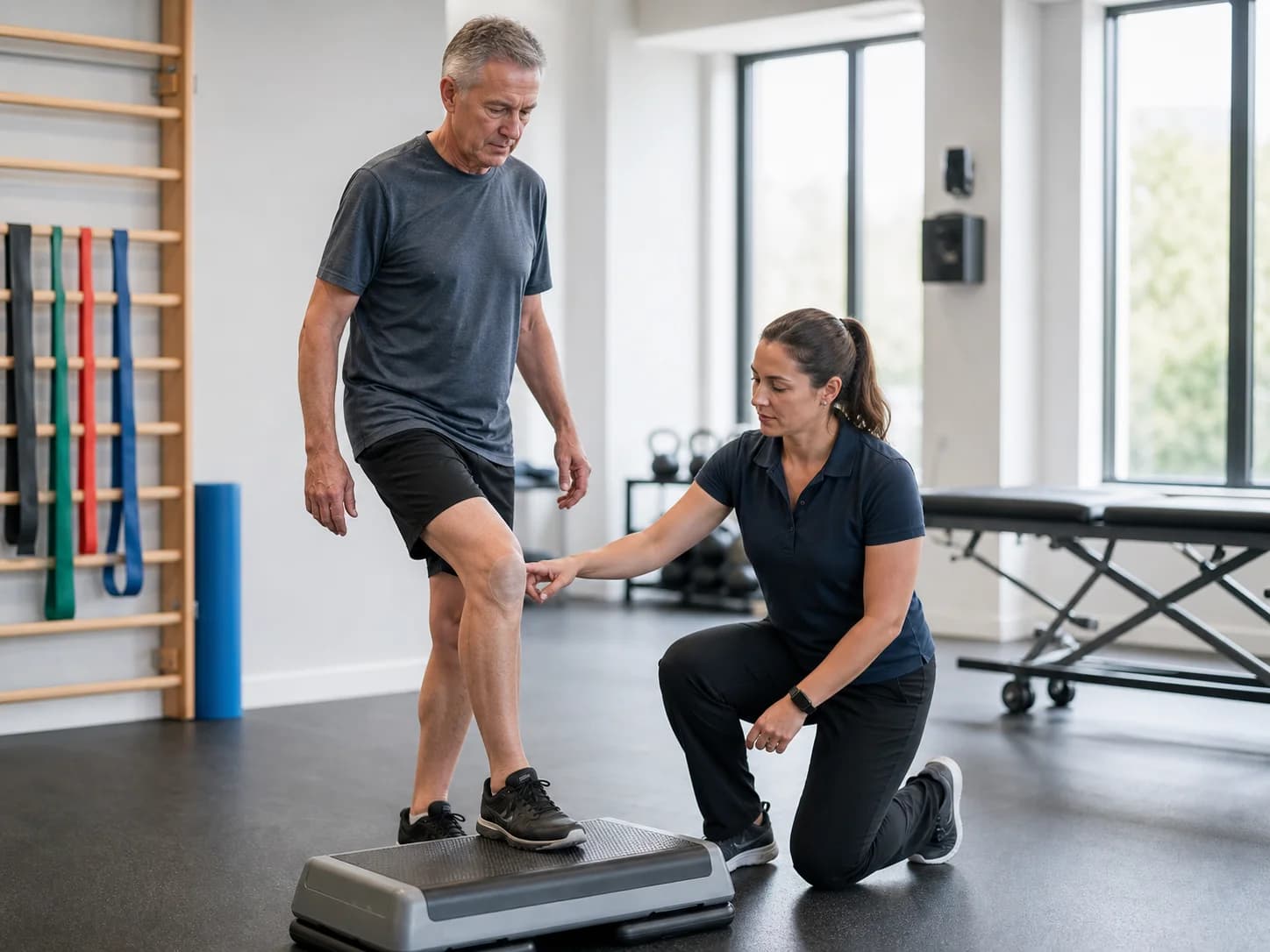
CartiHeal is implanted into subchondral bone as well as cartilage. Early rehabilitation therefore protects the osteochondral site while controlling swelling, restoring range and maintaining strength in safe ways.
Weight-bearing and movement restrictions cannot be reduced to one generic timetable. Lesion location, number of implants, associated procedures, bone quality and the current surgical protocol all influence the plan.
- Follow the individual weight-bearing instruction
- Control swelling and regain movement in the prescribed range
- Maintain hip, core and unaffected-limb capacity
- Protect the site from premature impact and twisting
Early rehabilitation priorities
Protection does not mean inactivity
- 1Protect loadingUse the prescribed weight-bearing aid and avoid premature impact or twist.
- 2Control swellingUse symptoms and effusion as feedback while the knee settles.
- 3Restore movementRegain range within the limits set for the lesion and associated procedures.
- 4Maintain capacityTrain the hip, core and unaffected limb without compromising the repair site.
Progressive loading
Function returns in stages
- 1Protected movementMobility and range come before unrestricted loading.
- 2Strength and controlBuild force capacity without provoking swelling or loss of movement.
- 3Function-specific loadingWalking, cycling and task demands progress before running and pivoting.
- 4Long biological changeManufacturer information describes remodelling broadly over 12–18 months.
Biological remodelling
The scaffold changes over months, not days
Smith+Nephew describes progressive resorption and replacement of the scaffold broadly over 12 to 18 months. The upper and lower zones occupy different biological environments, so recovery is not equivalent to waiting for a simple skin wound to heal.
Clinical improvement, load progression and tissue remodelling do not necessarily move at the same speed. Feeling better is not by itself permission to skip stages.
Return to function
Strength, control and impact are rebuilt in sequence
Rehabilitation progresses from protected movement to strength, balance, cardiovascular work and task-specific loading. Running, pivoting and impact require greater osteochondral tolerance than level walking or controlled cycling.
Follow-up considers symptoms, swelling, movement, strength and function. Imaging may be used when clinically indicated, but progress is not defined by a scan alone.
Progress markers
Return is earned by function, not a calendar alone
Swelling response
The knee should tolerate the current load without a sustained reaction.
Range of movement
Movement should support the next task rather than compensate around it.
Strength symmetry
Force and endurance are rebuilt progressively across the whole limb.
Movement control
Quality under load matters before impact, speed or change of direction.
Task tolerance
The knee must cope with the demands below the intended activity.
Clinical review
Symptoms, examination and imaging are interpreted together when needed.
CartiHeal recovery questions
How long does CartiHeal take to remodel?
Manufacturer information describes progressive resorption and replacement broadly over 12 to 18 months. Individual biological and clinical recovery varies.
Will I need crutches?
Protected weight-bearing is part of many osteochondral rehabilitation plans. Exact use depends on lesion location, implant number, associated procedures and current protocol.
When can I run?
Impact follows adequate healing, strength, control and tolerance of lower-load activity. A safe date cannot be set without the individual surgical and rehabilitation plan.
Does feeling better mean the implant has fully remodelled?
No. Symptoms and biological remodelling can progress at different rates. Activity should follow the agreed stages even when the knee feels improved.
Still have more specific concerns?
Free Discovery CallOptions that our doctors may discuss include NanoACi, ChondroFiller, Mytocel MSK, joint replacement, established conservative care or surgery, depending on examination and imaging.
Understand the rehabilitation commitment
CartiHeal is now available for suitable patients. Professor Lee can explain the operation, the protection your lesion would require and how rehabilitation affects the decision.